


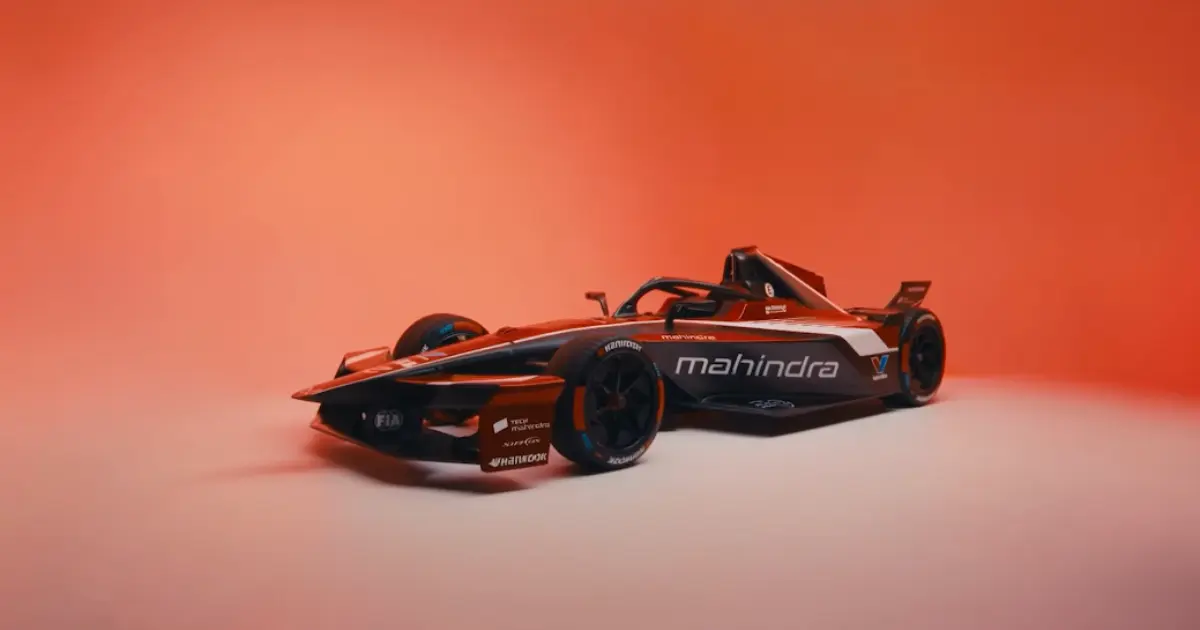
Seeing the Mahindra Racing Formula E car unveiled at Davos was a masterclass in global visibility. For me, its power wasn’t just in its speed, but in its symbolic livery: twelve stripes mirroring the Indian flag. That design boldly represents India’s growing presence in elite motorsport, turning the car into a moving statement of national ambition on the world stage.
Looking back at their journey since entering the Formula E championship back in 2014, it’s been fascinating to watch Mahindra Racing grow into a true contender on the global electric racing stage. The real proof of their progress came in the intense 2024-25 season, where the team clinched a hard-earned fourth-place finish in the series.
That result, beating established rivals like Neom McLaren and Maserati MSG, wasn’t just a statistic—it was a statement. For me, the highlight that truly showcased their competitiveness was Edoardo Mortara’s standout performance at the Mexico City E-Prix. Securing second place in Round 2, he demonstrated incredible skill, but more importantly, he proved the raw potential of Mahindra’s GEN3 Evo package. Watching that race, you could feel the team’s momentum shift from hopeful participant to genuine podium threat.
The Davos Showcase: A Car as a Canvas
The true impact of a racing car often happens off the track. Building on their recent momentum and the podium success from Mortara in Mexico, Mahindra Racing made a strategic move by placing their Formula E machine on display at the global stage of Davos. This showcase wasn’t about a new car—it was the same one unveiled in India last October—but about a deeper commitment.
As a fan, seeing it there in its new design, a sharp blend of metallic red, gloss white, and carbon black, drove home their ambition. The twelve stripes on the bodywork, symbolizing each season of their journey, and the prominent Indian flag are more than decoration. For me, they powerfully tell the story of this sole Indian manufacturer competing at this level, reflecting national pride onto the world’s premier motorsport championship.
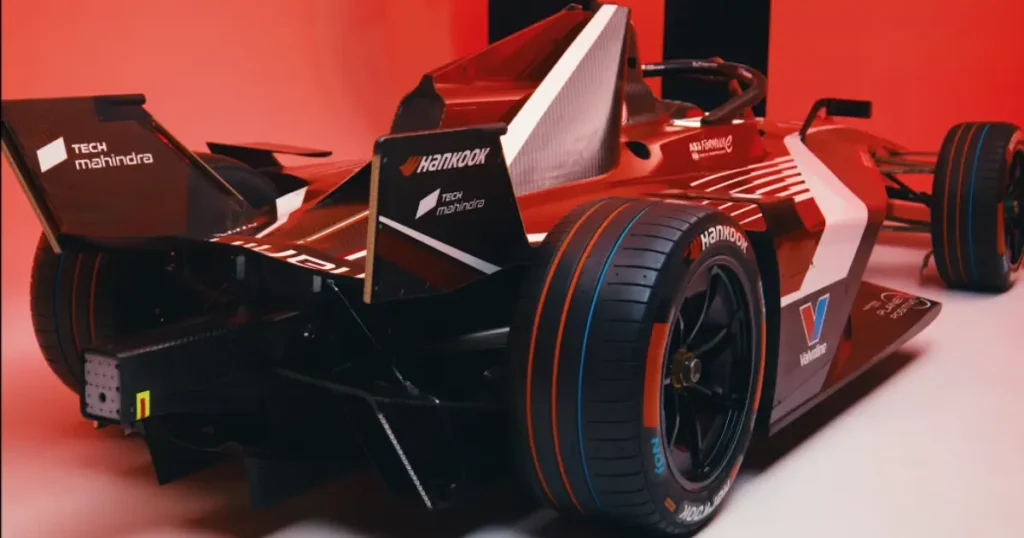
At its heart, this progress is driven by the Mahindra M12Electro itself, the latest phase of the team’s relentless development efforts. Beneath its familiar livery, this model hides critical refinements from a busy summer where engineers were working extensively to enhance every part of the GEN3 Evo package. Observing Season 11, it’s clear these technical updates have directly contributed to a noticeable resurgence in the car’s form. As someone who follows the ABB FIA Formula E World Championship closely, this reinforcing of Mahindra’s on-track competitiveness feels like a payoff for the hard work we saw happening behind the scenes.
Also Read: Tata Avinya: Not Just an SUV, But a New Electric Philosophy for India
Engineering the M12Electro: Where Specs Meet the Street
Behind the strategy and the livery lies the core engineering marvel: the Mahindra M12Electro. This isn’t just any race car; it’s a purpose-built machine for the unique demands of competitive street racing. Its lightweight construction, at just 840kg, is designed for razor-sharp agility between concrete walls, while its strong performance specs—like a top speed of 200 mph (320km/h) and a maximum output of 350kW (470 bhp)—deliver the explosive acceleration Formula E is famous for. For me, the real game-changer in this electric formula is the staggering 600kW charging capability.
This rapid energy replenishment during a race is what separates contenders from also-ran, and it perfectly reflects Mahindra Racing’s core focus: a relentless pursuit of efficiency, speed, and reliability in the ultimate Formula E competition. These technical attributes collectively define what makes a winner in this championship.
